Windfalls of War

Private contractors

Reports on the use of contractors in Iraq have disclosed that private-sector employees have been performing sensitive intelligence work in and around combat zones. What's more, the report by Major General Antonio Taguba on the alleged abuse of prisoners at the Abu Ghraib Prison noted the involvement of civilian contractors at the Baghdad facility.

These revelations have raised questions about the efficacy and permissibility of using private contractors to perform military intelligence functions, but a three-and-a-half-year-old memorandum shows that the Army has been well aware of the risks of calling on contractors for intelligence work. On December 26, 2000, Patrick T. Henry, assistant secretary of the Army, dispatched a memo to the Army's assistant deputy chief of staff for intelligence declaring a policy that not only restricted the use of contractors, but also cautioned against the threats to national security posed by reliance on such workers in sensitive intelligence functions.

"At the tactical level," the memo declared, "the intelligence function under the operational control of the Army performed by military in the operating forces is an inherently Governmental function barred from private sector performance." In addition, Henry's memo noted, the "oversight exerted over contractors is very different from the command and control exerted over military and civilian employees. Therefore, reliance on private contractors poses risks to maintaining adequate civilian oversight over intelligence operations."

Even at the "operational and strategic level," the memo notes, "the intelligence function … should be exempted from private sector performance on the basis of risk to national security from relying on contractors to perform this function. …

National Security

Early warning

By Alan Green

One year before the U.S. invasion of Iraq, then-Secretary of the Army Thomas E. White informed a trio of top-level Department of Defense officials that the army lacked the basic information required to effectively manage its burgeoning force of private contractors.

Windfalls of War

Former Vice President Dick Cheney stepped down from Halliburton to become Bush's running mate in Aug. 2000. KBR, a Halliburton subsidiary, was the top recipient of federal contracts during the first two years of conflict in Iraq and Afghanistan. Charlie Riedel/AP

Winning contractors

More than 70 American companies and individuals have won up to $8 billion in contracts for work in postwar Iraq and Afghanistan over the last two years, according to a new study by the Center for Public Integrity. Those companies donated more money to the presidential campaigns of George W. Bush—a little over $500,000—than to any other politician over the last dozen years, the Center found.

Kellogg, Brown & Root, the subsidiary of Halliburton—which Vice President Dick Cheney led prior to being chosen as Bush's running mate in August 2000—was the top recipient of federal contracts for the two countries, with more than $2.3 billion awarded to the company. Bechtel Group, a major government contractor with similarly high-ranking ties, was second at around $1.03 billion.

However, dozens of lower-profile, but well-connected, companies shared in the reconstruction bounty. Their tasks ranged from rebuilding Iraq's government, police, military and media to providing translators for use in interrogations and psychological operations. There are even contractors to evaluate the contractors. 

Nearly 60 percent of the companies had employees or board members who either served in or had close ties to the executive branch for Republican and Democratic administrations, for members of Congress of both parties, or at the highest levels of the military.

The results of the Center's six-month investigation provide the most comprehensive list to date of American contractors in the two nations that were attacked in Washington's war on terror. Based on the findings, it did not appear that any one government agency knew the total number of contractors or what they were doing. Congressional sources said they hoped such a full picture would emerge from the General Accounting Office, which has begun investigating the postwar contracting process amid allegations of fraud and cronyism.

Windfalls of War

Cutting through the fog of war

By Daniel Politi

Raytheon Aerospace, which changed its name to Vertex Aerospace in June 2003, and its related companies have received more than $2.7 billion in U.S. government contracts since 1990, and the company is currently in Afghanistan with a contract from the Defense Department worth at least $7.4 million involving aircraft repair and maintenance.

If Raytheon had its way, that might be all that is known about its work for the Pentagon.

Under a presidential directive signed by Ronald Reagan on June 23, 1987, known as Executive Order 12600, companies have potential veto power over Freedom of Information Act requests for copies of their contracts with the U.S. government.

To comply with the Executive Order, before releasing any contract, a FOIA officer must contact the company to ask whether there is any information that should be withheld because it constitutes confidential commercial information that could cause competitive harm if released. Withholding this information is allowed under Exemption 4 of the Freedom of Information Act, which states that records cannot be obtained if they contain "trade secrets and commercial or financial information obtained from a person and (are) privileged or confidential."

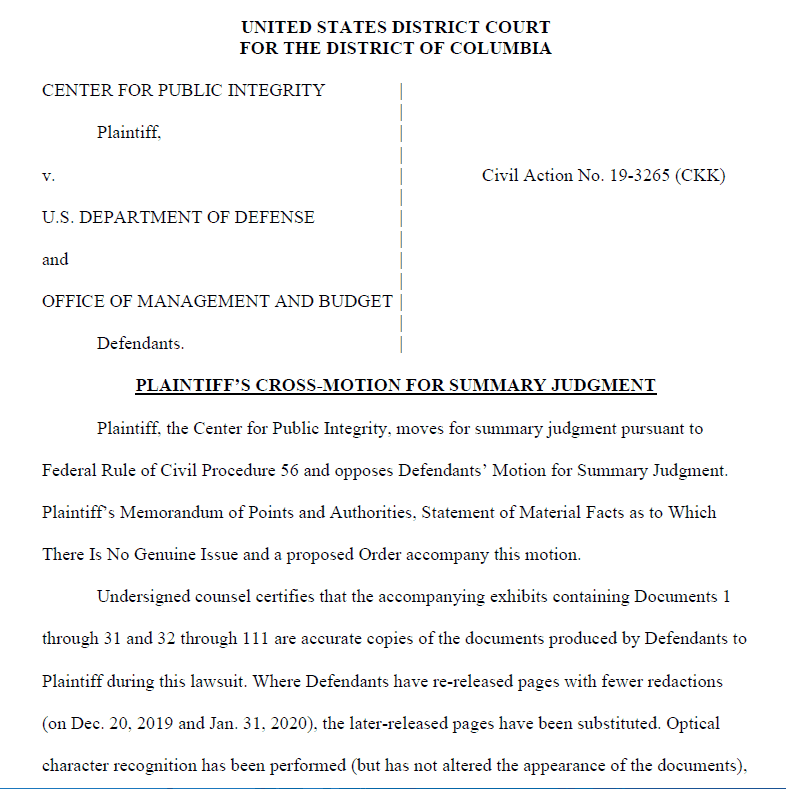
In trying to determine which U.S. companies received government contracts for work in post-war Iraq and Afghanistan, the Center for Public Integrity filed 73 FOIA requests and appeals with the State Department, the U.S. Agency for International Development and the Pentagon and its related uniformed services.

In an initial response in May, the Pentagon listed a $7,382,194 contract with Raytheon for work in Afghanistan. But requests for a copy of the actual taxpayer-funded contract remain pending.

Windfalls of War

Outsourcing government

By Laura Peterson

Government contracting has always been a complex matter, thick with legal wrangling and bureaucracy, but the last decade has seen a radical change in how the U.S. government purchases goods and services.

At one time, federal agencies constructed buildings, built machines and cleaned offices themselves, or found another agency to do it. Today, the U.S. government spends some $200 billion a year buying everything from information technology services to pencils to advanced weapons systems from the private sector.

The Defense Department alone accounts for 75 percent of that spending. Following a series of scandals in the 1980s, where the Pentagon was revealed to have paid outrageous sums for commercially available products, Congress decided to overhaul government procurement. The result was the Federal Acquisition Streamlining Act of 1994, which simplified the maze of procurement regulations to make it easier for federal agencies to buy products from the private sector.

The new law dovetailed with former Vice President Al Gore's "Reinventing Government" initiative, which aimed to trim the federal workforce, and matched the realities of the Pentagon's shrinking budget. As a result, where the federal workforce has shrunk, the contractor workforce has grown. Paul Light, a scholar at the Brookings Institution, calls this workforce the "shadow government," and estimated its size in 1999 at 5.6 million.

More than half of all government contracting today is spent on services—an increase of about 24 percent since 1990—making it the largest spending category. "Twenty years ago, (the government) contracted for supplies, construction and services, in that order. Now it's services, supplies and construction, but services are what's driving the train," says Steven Schooner, associate professor and co-director of the government Procurement Law Program at George Washington University.

Windfalls of War

Oil immunity?

By André Verlöy

On May 22, the U.N. Security Council gathered in New York to approve a resolution lifting sanctions on Iraq, creating a Development Fund for the country and providing limited immunity to corporations involved in oil and gas deals there for the next four years. The resolution directed that proceeds from future sales of Iraqi oil and gas be placed in the development fund and allowed the U.S.-led Coalition Provisional Authority to disburse the funds in consultation with the interim Iraqi administration.

That same day at the White House, President George W. Bush signed Executive Order 13303, which appears to give immunity from any judicial process to every entity with direct or indirect interests in Iraqi petroleum and related products. "The threat of attachment or judicial process against the Development Fund for Iraq, Iraqi petroleum and petroleum products, and interests therein ... constitutes an unusual and extraordinary threat to the national security and foreign policy of the United States," reads the executive order. It continues, "… any … judicial process is prohibited, and shall be deemed null and void."

Executive Order 13303 went unnoticed outside the government until July, when it was spotted by the Institute for Policy Studies, a liberal think tank.

Since then, accusations have been flying over whether or not the Bush administration has given blanket immunity to the oil industry in Iraq. "The Executive Order is a blank check for corporate anarchy," Tom Devine, legal director of the non-profit Government Accountability Project, wrote in a July 2003 assessment of the order for the Institute. "Its sweeping, unqualified language places industry above domestic and international law for anything related to commerce in Iraqi oil."

"Translated from the legalese, this is a license for corporations to loot Iraq and its citizens," Devine added.

Windfalls of War

A family connection

One of the more interesting Iraq contracts the Center uncovered involves a tiny firm called Sullivan Haave Associates.

Sullivan Haave is actually a one-man shop run by a government consultant named Terry Sullivan. Sullivan says his firm was hired as a subcontractor by Science Applications International Corp., one of the most successful and best politically connected government contractors doing work in Iraq.

Sullivan says his job was to spend four months in Iraq providing advice to various ministries being set up there by coalition and local authorities.

Sullivan has a much more intimate relationship with the Pentagon than his competitors, however. He happens to be married to Carol Haave, who, since November 2001, has been deputy assistant secretary of defense for security and information operations. And yes, Haave is the same person who appears in the name Sullivan Haave Associates.

Haave seemed surprised when contacted by the Center for Public Integrity at her Pentagon office about the contract.

She said she was no longer associated with the company in any way. She then said she had no knowledge of any work the company might be doing in Iraq.

When asked who the Center might speak with about the contract, Haave said that person was currently out of the country and unavailable. She said she would try to reach the person and have him call the Center.

A short time later Sullivan called.

He said the contract had only been for four months and he had completed it in July. He said he did not know what the total cost of the contract was. "They paid me for four months of my time," he said.

Sullivan then disclosed that Haave was his wife, but said the contract had nothing to do with her position at the Pentagon.

"We have been very sensitive to the issue of conflict for a long time," said Sullivan, who said his wife had signed everything involving the company over to him before she took her current job.

Windfalls of War

Anatomy of a contract

The Pentagon has awarded seven contracts to San Diego-based Science Applications International Corp. to oversee much of the massive jobs of building a new government and mass media in post-war Iraq. Although the Defense Department and SAIC have chosen to keep much of the contract information secret—including the cost—the Center for Public Integrity has been able to glean some interesting details about the deals, which were all awarded in February 2003. The contracts all appear to last for one year and call for all of the work to be directed by Undersecretary of Defense for Policy Douglas Feith. Feith's top deputy at the Pentagon is Christopher "Ryan" Henry. Henry was a senior vice president at SAIC until October 2002.

One contract calls for SAIC to hire 150 so-called "Subject Matter Experts" who have been identified by the U.S. government as having "demonstrated an understanding of government operations required in (Iraq); language, cultural and geographic issues; and local recruitment requirements in (Iraq)." Specifically, the contract says the SMEs will, among other tasks, "identify, contact and recruit individuals in the exile and captive Iraqi community who are willing to devote themselves to the reconstruction and stability of Iraq." The contract requires SAIC to lease apartments, cover living expenses and provide support staff and services for the SMEs. Much of the work is to be done in Arlington, Va., but the contract does require the SMEs to deploy to Iraq for no fewer than 30 days. Although most of the dollar figures in the contracts were removed by the Pentagon in copies supplied to the Center for Public Integrity, one section indicates that, for certain "executive management consultants," the company will be paid $209 per hour.

Windfalls of War

Contracts with provisional authorities

By Kevin Baron, Neil Gordon and Laura Peterson

While the Defense and State Departments have granted the lion's share of contracts in Iraq and Afghanistan directly from Washington, a few U.S. companies have made their deals directly with local governing authorities that have emerged with U.S. support or direction.

The companies do not appear on the lists of contracts the Center for Public Integrity obtained under the Freedom of Information Act; their direct dealings with the provisional authorities in Iraq and Afghanistan demonstrate the complexity of tracking the role of private companies in the post-war countries.

Three U.S. companies—banking and brokerage powerhouse J.P. Morgan Chase, oil giant Chevron/Texaco and global telecommunications provider MCI—have won contracts from the Coalition Provisional Authority in Iraq, the Iraq State Oil Marketing Organization, and the Afghanistan provisional government.

In Iraq, Peter McPherson, director of economic development for the Coalition Provisional Authority—whose members were appointed by Coalition Provisional Authority Administrator L. Paul Bremer on July 13, 2003—told reporters in an Aug. 29, 2003, teleconference from Baghdad that CPA will pay J.P. Morgan Chase $2 million over an up-to-three-year period to run an operating consortium of 13 banks from 13 countries that will constitute the Trade Bank of Iraq. The temporary bank's role is to issue and confirm credit letters to facilitate and encourage immediate importation of items like food, electrical equipment, and oil refinery machinery, and later that will allow for trade in oil and heavy machinery, worth hundreds of millions of dollars and effectively phasing out the UN oil-for-food program.

National Security

Interview: Not in the U.S. of A?

By Charles Lewis

A month before the terrorist attacks on September 11, 2001 and all of the increased government secrecy that has ensued, the Justice Department secretly seized the home telephone records of respected investigative reporter and deputy bureau chief of the Associated Press in Washington, John Solomon. And earlier this year, the FBI opened and confiscated his mail. Center for Public Integrity executive director Charles Lewis recently interviewed Solomon about it.

Pages

Writers and editors

R. Jeffrey Smith

Managing Editor, National Security The Center for Public Integrity

Smith worked for 25 years in a series of key reporting and editorial roles at The Washington Post, including ... More about R. Jeffrey Smith

Douglas Birch

The Center for Public Integrity

Veteran foreign correspondent Douglas Birch has reported from more than 20 countries, covered four wars, a dozen elections, the deat... More about Douglas Birch