Fast and Furious

 Rep. Darrell Issa (R-Calif.) and Attorney General Eric Holder AP

A 'Fast and Furious' fight in the House

By Gordon Witkin

The now-infamous Fast and Furious gun trafficking probe is returning to center stage as part of an “only in Washington” passion play — a fight over executive privilege. But the breathless showdown expected today on the floor of the House — and the accompanying rhetoric — obscures some important context about the botched investigation by the Bureau of Alcohol, Tobacco, Firearms and Explosives.

The House Oversight and Government Reform Committee, led by Rep. Darrell Issa, R-Calif., has been investigating Fast and Furious for months. The Justice Department has given the panel 7,600 documents on the case, but Issa and his investigators want other documents they believe to be crucial. President Obama, however, has countered by asserting executive privilege over some of the material. And so the House will likely vote on a contempt of Congress recommendation against Attorney General Eric Holder. No sitting attorney general has ever faced a contempt vote.

Against that backdrop, a standard narrative has emerged about Fast and Furious, describing the operation as a seemingly ludicrous effort that allowed hundreds of firearms to “walk” to the Mexican drug cartels by way of so-called straw purchasers.

Indeed, there is much about Fast and Furious to question — but it’s simplistic to view the probe in isolation. A look behind the curtain reveals a more complex back story — a story about a rudderless, under-staffed agency responding to Justice Department pressure, while dealing with inadequate laws, paltry sentences and disinterested U.S. Attorneys.

Much of that context was detailed by the Center for Public Integrity during the early days of the Fast and Furious scandal, and it’s still both relevant and illuminating today.

We invite you to read our earlier piece.  

Up in Arms

U.S. Army soldiers board a C-17 aircraft at Baghdad International Airport bound for the United States. Maya Alleruzzo/AP

Congress can’t say no to military pay raises

By Zach Toombs

While civilian salary increases have slowed to a crawl in the last five years, a new Pentagon report shows rapidly-growing military payrolls have proved immune to the economic pain felt in the private sector.

The Defense Department’s latest Quadrennial Review of Military Compensation confirms that after years of special benefits provided by Congress, it's now much more lucrative to be a soldier than a civilian. While average pay for civilians with a two-year college degree rises $3,000 between their tenth and twentieth year in the workforce (to reach $45,000), comparable enlisted Defense personnel see their salaries increase $15,000 in that time (to reach $73,000).

In fact, at every point in someone’s career, pay in the armed services tops that of civilians. In their first year, military officers make $20,000 more than private sector workers with a bachelor's degree, according to the review by representatives from the Army, Navy, Air Force, Marine Corps, National Guard and various Defense bureaus. By their twentieth year, that difference has grown to $60,000. And the shortfall is larger for civilians with some college experience or a high school diploma.

National Security

An Egyptian protester displays a non-exploded U.S.-made tear gas bomb after clashes between protesters and anti-riot policemen near the Israeli embassy in Cairo, Egypt, in September 2011. Amr Nabil/AP

U.S. points finger, and arms exports, at human rights abusers

By Zach Toombs and R. Jeffrey Smith

Every May and June, different branches of the State Department paint contrasting portraits of how Washington views dozens of strategically significant countries around the world, in seemingly rivalrous reports by its Human Rights and Political-Military Affairs bureaus.

The former routinely criticizes other nations for a lack of fealty to democratic principles, citing abuses of the right to expression, assembly, speech and political choice. The latter tallies the government’s latest successes in the export of American weaponry, often to the same countries criticized by the former.

This year was no different. The State Department’s Military Assistance Report on June 8 stated that it approved $44.28 billion in arms shipments to 173 nations in the last fiscal year, including some that struggled with human rights problems. These nations include the United Arab Emirates, Qatar, Israel, Djibouti, Honduras, Saudi Arabia, Kuwait, and Bahrain.

Three nations with records of suppressing democratic dissent in the last year — Algeria, Egypt, and Peru — are listed in the report as recently receiving U.S. firearms, armored vehicles, and items from a category that includes chemical and riot control agents like tear gas. The State Department confirmed that U.S. tear gas was delivered to Egypt up to the end of November, but has declined to confirm it was also sent to Algeria and Peru.

Up in Arms

More fun facts about the F-35 fighter

Here are some raw numbers about the costliest military program in U.S. history: The F-35 jet fighter. Three different versions of the plane are being developed, and a total of 2,457 copies are to be manufactured by 2035. (See our first set of F-35 facts here.)

.5

Current number of “flying hours between failures” for the Marine Corps F-35 (a statistical mean)

2.6

Current number of “flying hours between failures” for the Air Force F-35

4

Required number of “flying hours between failures” for the Marine Corps F-35

6

Required number of “flying hours between failures” for the Air Force F-35

73

Percentage increase in cost of F-35 engine since development began in 2002

365

Number of planes the Pentagon says it will build by 2017

1,591

Number of planes the Pentagon said ten years ago that it would build by 2017

$22,500

Cost to fly the F-16 – which the F-35 is replacing – for one hour

$35,200

Cost to fly the F-35 for one hour (if current Air Force targets are met)

$672 million

Taxpayer’s share of a billion dollars in cost overruns on early F-35 production contracts

Source:“Joint Strike Fighter,” Government Accountability Office, June 2012, GAO-12-437

National Security

On left: Simulated display of F-35 helmet symbology from Vision Systems International Visions System International/YouTube, UK Ministry of Defence

Bouncing too much to find the enemy

By R. Jeffrey Smith

A host of problems plague the military’s newest jet fighter, the F-35, but one of the simplest yet most troublesome is identified in a new government audit as unreadable “symbology.”

The problem exists inside a small item at the heart of what makes the F-35 the world’s most sophisticated aircraft — if only it could be made to work. Namely, the pilot’s helmet visor. On the world’s most advanced, fifth-generation military aircraft, the visor is meant to be much more than a sun shield. It is supposed to do wondrous things.

Acting like a small, see-through movie screen, it is designed to display data showing how the plane is performing, where enemy targets are, and which weapons the pilot can use to handle them. As the pilot swivels his head, the display is meant to adapt, creating a direct link — as in a science-fiction movie — between the pilot and the aircraft’s unprecedented computing power.

The visor is, according to the Government Accountability Office’s latest annual report on the F-35’s development, “integral to the mission systems architecture.” In other words, the plane was more or less designed around the unique capabilities of that fancy helmet appendage.

Just one problem: It doesn’t work. In flight tests, the visor’s “symbology” has evidently been unreadable, because the plane itself has been bouncing up and down in the air more than expected. The effect is probably like trying to read an e-book while riding a bicycle along a boulder-strewn path.

“Display jitter,” the GAO report says in a footnote, “is the undesired shaking of display, making symbology unreadable … [due to] worse than expected vibrations, known as aircraft buffet.”

Up in Arms

U.S. Customs and Border Protections's unmanned aircraft arrives for a 2009 air show in Oshkosh, Wis.  U.S. Customs and Border Protection website

Drones not used effectively on U.S. borders

By Aaron Mehta

The key military role played by the over 7,500 drones used by the Pentagon is well-known. But until recently, the deployment of drones by the government inside U.S. borders has attracted little attention or critical oversight.

Now a new internal audit from the Department of Homeland Security (DHS) has raised concerns about the utility of those drones, focusing on their high costs and how they have been managed.

DHS has spent more than $250 million on its program in the past six years, and currently has nine Predator drones on call. While each drone is purchased at a cost of around $18 million each, the GAO estimated that the hourly charge is $3,234 — or almost $65,000 per 20-hour mission.

The majority of the drones are based on the U.S./Mexico border, where a growing drug war has slowly seeped into parts of California and Texas. But drones also scout the border with Canada. Homeland Security Secretary Janet Napolitano testified last month that UAVs were patrolling from North Dakota to eastern Washington State.

The program has had a series of operational troubles, the IG report reveals. For example, the drones have required an hour of maintenance for every hour they fly, significantly increasing their expense. Additionally, inspectors found that the drones were often grounded by bad weather.

Up in Arms

Afghan policemen simulate weapons orientation during a trainning session with US soldiers from 2nd PLT Diablos 552nd MIlitaryPolice Company, on the outskirts of Kandahar City, Afghanistan, October 2010. Rodrigo Abd/AP

Army's mishandling of Afghanistan police contract boosted costs

By Zach Toombs

As the U.S. military heads for the door in Afghanistan, one of its most important tasks is to train Afghan police to take control of the nation’s security. But a billion-dollar Afghan police training contract, now being administered by the Army, has encountered some troubles, according to a new report by the Defense Department’s Inspector General’s office.
In just the first four months after the contract was signed in December 2010, its cost shot up $145 million, or 14 percent. A series of late revisions has slowed the training process for Afghan police, the IG report said, and the contract has been written in a way that allows new costs to accumulate without penalty.

The IG blamed the Army for the early cost hike, asserting that those overseeing the work by the lead contractor, DynCorp International, should have anticipated that its scope would be greater than initially estimated.

National Security

Iraqi men throw rocks at an American humvee that burns after it came under attack during a shootout in the Iraqi town of Fallujah, west of Baghdad, in March 2004. Khalid Mohammed/AP

U.S. military admits major war mistakes

By R. Jeffrey Smith

When President Obama announced in Aug. 2010 the end of U.S. combat operations in Iraq, he complimented the soldiers who had served there for completing “every mission they were given.” But some of military’s most senior officers, in a little-noticed report this spring, rendered a harsher account of their work that highlights repeated missteps and failures over the past decade, in both Iraq and Afghanistan.

There was a “failure to recognize, acknowledge and accurately define” the environment in which the conflicts occurred, leading to a “mismatch between forces, capabilities, missions, and goals,” says the assessment from the Pentagon’s Joint Staff. The efforts were marked by a “failure to adequately plan and resource strategic and operational” shifts from one phase of the conflicts to the next.  

From the outset, U.S. forces were poorly prepared for peacekeeping and had not adequately planned for the unexepected. In the first half of the decade, “strategic leadership repeatedly failed,” and as a result, U.S. military training, policies, doctrine and equipment were ill-suited to the tasks that troops actually faced in Iraq and Afghanistan.

These self-critical conclusions appear in the first volume of a draft report titled “Decade of War” — part of a multi-volume survey of “enduring lessons” from the past ten years of conflict. When completed, “it will be used by senior leaders” to develop U.S. military forces for the future, according to Navy Lt. Cmdr. Cindy Fields, a Joint Staff spokeswoman.

Fields said the 36-page, May 2012 report remains an internal document and is not available to the public, but a copy was posted Thursday on the website of a trade publication called "Inside the Pentagon" (accessible only to regular or trial subscribers).

Up in Arms

A fire burns on the USS Miami, a nuclear submarine, at the Portsmouth Naval Shipyard in Kittery, Maine, May 23, 2012. WMUR, Jean Mackin/AP

Vacuum cleaner sucks $440 million from Navy

By Aaron Mehta and Zach Toombs

Update, July 24, 2012, 2:37p.m.: A civilian worker admitted to starting the fire aboard the USS Miami to leave work early, according to an affidavit filed by the Navy Criminal Investigative Service with the United State District Court in Portland, Maine. It said that while Casey James Fury was undergoing a lie-detector test, he told the NCIS he set fire to a few rags in a bunk room in the submarine, starting the fire that resulted in $400 million of damage to the vessel.

According to the seven-page affidavit, at the time he started the fire, Fury was anxious over a text message exchange with his ex-girlfriend about a man she had begun dating. Fury faces two counts of arson. If convicted of either, he could see a maximum penalty of life imprisonment and be forced to pay a fine of up to $250,000 along with restitution for damage caused to the submarine.

It can take a powerful enemy to damage the nuclear powered submarines that form the linchpin of the U.S. naval arsenal. The most worrisome threats are usually sub-killing torpedoes or large mines. But the subs’ designers evidently forgot to incorporate countermeasures against another threat: vacuum cleaners.

According to a news release Friday from the Portsmouth Naval Shipyard, it was a vacuum cleaner that caused an estimated $400 million in damages to the nuclear-powered USS Miami on May 23. The 22-year-old Miami was docked at Portsmouth as part of a dry dock repair period when the fire broke out, and over the next 12 hours it damaged crew quarters as well as command spaces and the torpedo room.

National Security

House Armed Services Committee chairman Howard “Buck” McKeon (R-Cal.), whose district includes facilities operated by Boeing, Northrop Grumman and Lockheed Martin, is the top House recipient of funding from nuclear weapons contractors. J. Scott Applewhite/AP

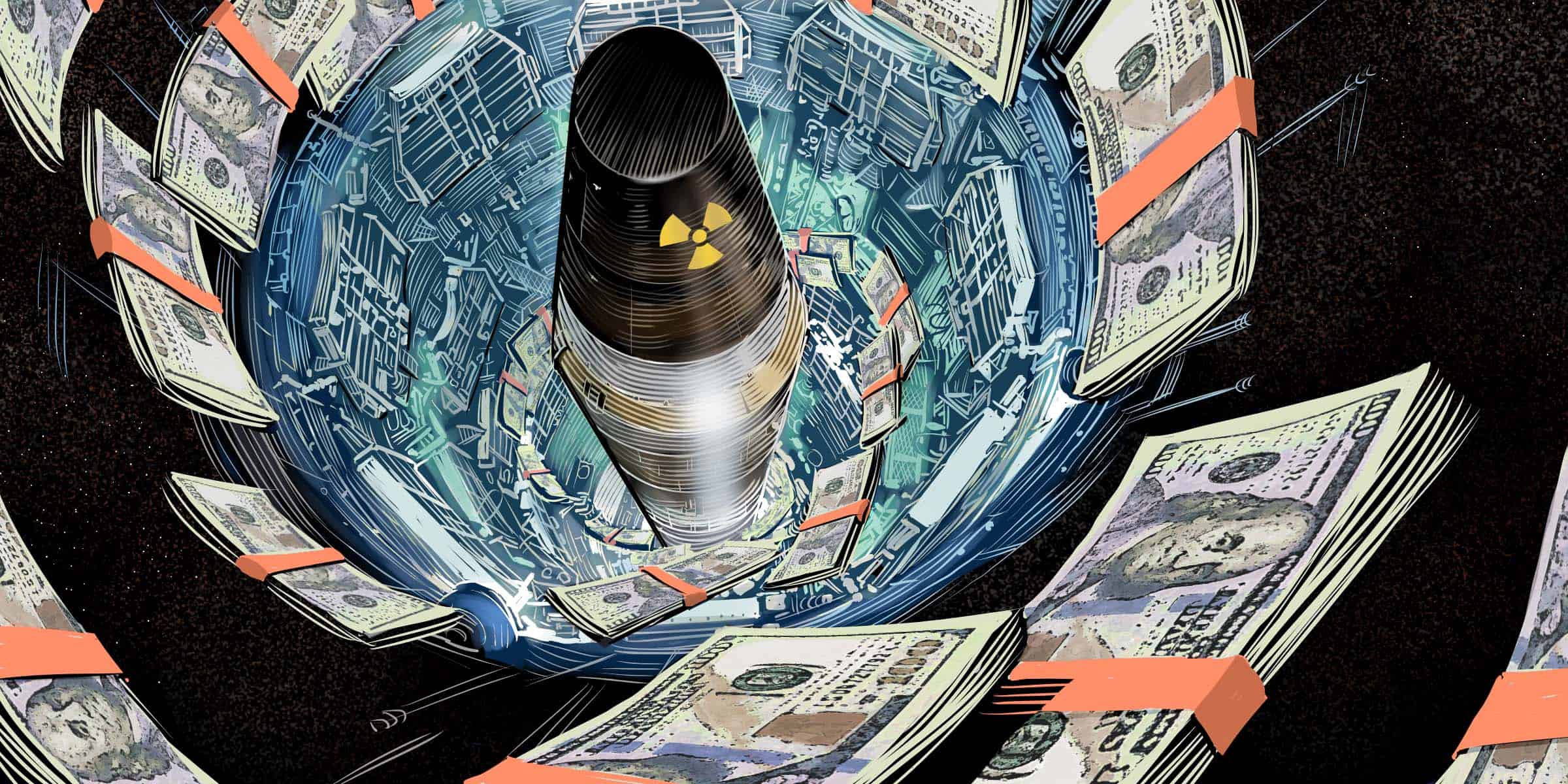
Are nuclear weapons contractors’ millions in campaign contributions buying favors?

By R. Jeffrey Smith

Employees of private companies that produce the main pieces of the U.S. nuclear arsenal have invested more than $18 million in the election campaigns of lawmakers that oversee related federal spending, and the companies also employ more than 95 former members of Congress or Capitol Hill staff to lobby for government funding, according to a new report.

The Center for International Policy, a nonprofit group that supports the “demilitarization” of U.S. foreign policy, released the report on Wednesday to highlight what it described as the heavy influence of campaign donations and pork barrel politics on a part of the defense budget not usually associated with large profits or contractor power: nuclear arms.

As Congress deliberated this spring on nuclear weapons-related projects, including funding for the development of more modern submarines and bombers, the top 14 contractors gave nearly $3 million to the 2012 reelection campaigns of lawmakers whose support they needed for these and other projects, the report disclosed.

Half of that sum went to members of the six key committees or subcommittees that must approve all spending for nuclear arms — the House and Senate Armed Services Committees and the Energy and Water or Defense appropriations subcommittees, according to data the Center compiled from the nonprofit Center for Responsive Politics. The rest went to lawmakers who are active on nuclear weapons issues because they have related factories or laboratories in their states or districts.

Pages

Writers and editors

R. Jeffrey Smith

Managing Editor, National Security The Center for Public Integrity

Smith worked for 25 years in a series of key reporting and editorial roles at The Washington Post, including ... More about R. Jeffrey Smith

Douglas Birch

The Center for Public Integrity

Veteran foreign correspondent Douglas Birch has reported from more than 20 countries, covered four wars, a dozen elections, the deat... More about Douglas Birch