

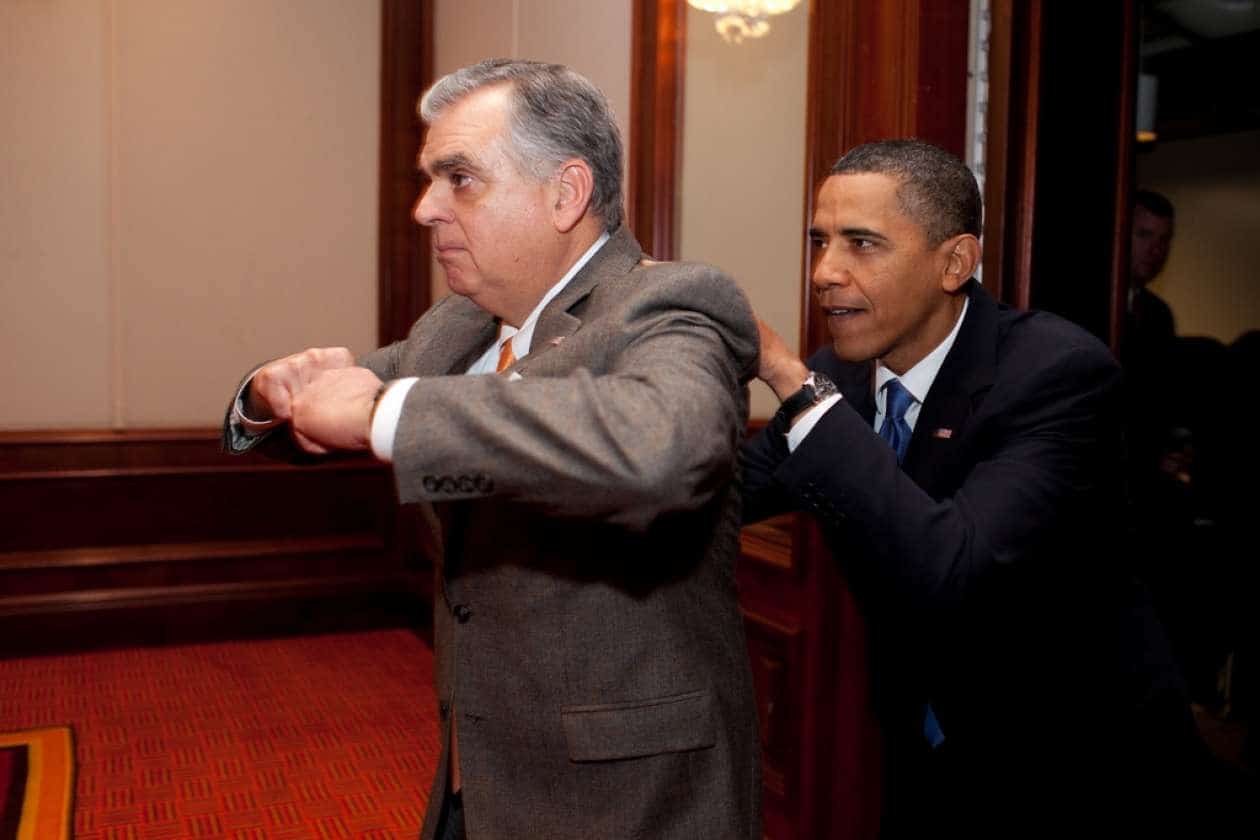
A veteran transportation lobbyist is hosting a fundraiser for Transportation Secretary Ray LaHood’s son, a fledgling state senator from Illinois.
The June 13 fundraising event was initially scheduled to be held at the Washington house of lobbyist Bernie Robinson, according to the invitation. But following inquiries by iWatch News, the venue was changed to the Capitol Hill Club.
Robinson, a partner with the lobbying powerhouse Livingston Group, works in the firm’s “Transportation, Shipbuilding, Shipping and Ports” division. He previously served as the chief lobbyist for the State of Illinois, and told iWatch News that his relationship with Sen. LaHood inspired him to set up the fundraiser.
“Darin is my friend and I’m happy to continue to support Darin,” Robinson said. He added that he has hopes for a solid turnout for the event. “As Darin has worked for Congress for four years and for the Department of Justice for five years and has numerous friends in this area, I’m hopeful that they will be able to participate.”
Sen. LaHood served as a congressional aide from 1990-1994 and much of the next decade as a state and district attorney before joining the private law firm of Miller, Hall & Triggs.
Robinson said that he had not invited Secretary LaHood to the event. “My focus has been on friends of Darin’s, Republicans and folks from Illinois who are here,” he said.
When asked if his decision to host the event had anything to do with Ray LaHood’s position as Secretary of Transportation, Robinson replied, “Fortunately I have the opportunity to advocate for clients on a wide variety of issues, including transportation. As I am not a registered lobbyist in Illinois, I have not lobbied Sen. LaHood.”
Sen. LaHood has been seated on the Transportation committee in the state Senate.
Patty Schuh, a spokeswoman for the Illinois Senate Republicans, confirmed with iWatch News that the event was being changed from Robinson’s home.
“To ensure the integrity of his upcoming D.C. event, Sen. LaHood has moved it to the Capitol Hill Club where he hopes many friends from Capitol Hill and the Department of Justice join him,” Schuh said in a statement. “After spending several years working in Washington, D.C., Darin LaHood has a wide network of friends and formers colleagues who have offered to help as he continues his career in public service.”
Schuh said Robinson previously hosted a fundraising event for LaHood at his home in May 2008.
The Livingston Group made at least $280,000 in the first quarter of this year from transportation and construction interests that could be impacted by decisions from the Department of Transportation, according to an iWatch News analysis of lobbying disclosure records. Robinson worked directly on contracts worth at least $1.86 million on a variety of topics, including transportation and construction issues.
Department of Transportation spokeswoman Jill Zuckman said in a statement that Secretary LaHood would not be at the fundraiser.
“Secretary LaHood is very proud of his son Darin and the work he is doing representing the people of Peoria in the Illinois Senate,” Zuckman said. “The Secretary is not attending his fundraiser. Sen. LaHood is an elected official in his own right with his own relationships that he established during the time he worked in Washington.”
Invitations to the fundraiser were sent out requesting donations of $250 per individual attendee, $1,000 per PAC attendee and $1,500 for sponsors. Included with the invitation was a newspaper clipping about Sen. LaHood’s swearing in ceremony, which quotes his father and lists his title. All proceeds will go to “Citizens for Darin LaHood,” which will fund LaHood’s announced 2012 election effort. According to FollowTheMoney.org, the average state Senate race in Illinois costs $423,365, although LaHood’s predecessor won re-election with no opposition.
Mary Boyle of Common Cause said that while it’s not unheard of for state senators to come to Washington for fundraisers, it’s far less common than for gubernatorial candidates. She said the fact that local politicians now travel to D.C. speaks to the fact that running for office “is getting more and more expensive, even at the state level, and candidates have to go where the money is.”
Before being tapped by President Obama to head the Department of Transportation, Ray LaHood served seven terms in the House of Representatives from Illinois’ 18th District. His son was appointed by the Republican County chairman in his district at the end of February to fill the seat of retiring State Sen. Dale Risinger. At the time, Secretary LaHood denied havingany impact on his son’s appointment.