

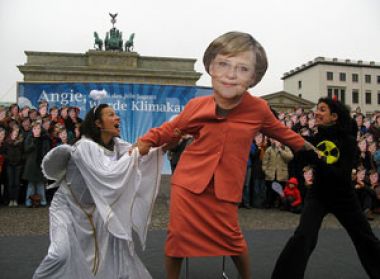
Copenhagen — The press room fell to a hush as German Chancellor Angela Merkel, then-president of the European Union, took the podium at a Brussels summit in March 2007. Merkel was announcing the EU’s new climate package, easily the world’s most impressive commitment so far to reducing climate change. As journalists scribbled, Merkel laid out what would become known as the EU’s 20-20-20 plan: to cut CO2 emissions by 20 percent, increase energy efficiency by 20 percent, and expand renewable use to 20 percent of energy by 2020. If an international agreement were reached, Merkel announced, the goal of CO2 reduction could even be raised to 30 percent.
It was an inspiring moment. “Europe has a pioneer role,” Merkel announced. “We believe that this role is necessary, not least in order to inspire and convince partners outside of Europe to similarly ambitious targets.” For Merkel, who had to unite EU nations behind a plan when she was Germany’s environment minister, the speech marked the culmination of years of dedication to curbing global warming.
Shepherding 27 countries toward an agreement had not been easy. Yet there had never been any question about the obligations of the EU — the world’s second-largest historical emitter of greenhouse gases — to reduce greenhouse emissions. The European ambition was not just the result of broad concern about the environment, but also about pride in being the world leader on the issue. The real concern now was how to distribute the burden of responsibility among EU nations, whose membership spans countries from Estonia and Romania to Luxembourg and the United Kingdom.
A Plan with Loopholes
Or so it seemed. As debate grew, it soon became clear that the scale of the EU’s ambitions was, in fact, an open question. Critics, for example, noted that the EU agreement assumes the year 1990 as a base level of comparison for reductions. Yet because emissions were significantly reduced in the 1990s after the collapse of industry in large parts of Eastern Europe, did counting those reductions accurately reflect the EU’s overall attempts to cut CO2? According to the British climate organization Sandbag, with 1990 as a base, even a 30 percent reduction by 2020 would account for only a 10 percent reduction in European emissions from current levels.
The 1990 baseline was not the only problem. The final climate package, passed by the European Parliament in December 2008, contained watered down provisions that disappointed many climate experts, including a mechanism that allows up to half of the EU’s reduction requirements to be met through investments in foreign carbon offset projects. The EU also decided to postpone full auctioning of CO2 permits until a set of benchmarks from the European Commission could determine which sectors are most susceptible to “carbon leakage,” or competition from outside the EU. Meanwhile, in Germany, Merkel was under heavy pressure from manufacturers, according to a recent report by the Pew Environment Group. Merkel fought to insert loopholes that offered free carbon credits to heavy industry and imposed weaker penalties for companies that did not comply.
“Lobbied like Hell”
To understand what happened, the International Consortium of Investigative Journalists conducted more than 40 interviews with leading EU climate experts, legislators, environmentalists, and industry representatives, as well as a review of EU lobbying records and of correspondence and agendas obtained under freedom of information laws. ICIJ’s reporting suggests that, far from the world’s most ambitious emissions-control plan, the EU’s position is filled with loopholes — the result of member governments succumbing to the pressure of manufacturing, utilities, transport, and other influential industries. “The German government, the French government, the British government — they’ve all been lobbied like hell,” says Jo Leinen, who chairs the European Parliament’s Committee on the Environment, Public Health, and Food Safety. In that sense, the EU shares much with the lobbying blitz by companies in major economies around the world. “Anyone who is energy intensive” lobbies, says Nick Campbell, who chairs the climate working group at BusinessEurope, which represents companies across the continent. “We see all the big companies, the big power guys, the oil companies. We see aluminum.”
Industry representatives aren’t trying to weaken any agreements, but merely to make them practical, insists Bill Kyke, a veteran lobbyist for German utility giant E.ON. “At the end of the day, negotiators may reach an agreement, but it’s the private sector that’s going to have to deliver,” says Kyke, who helped construct the original EU carbon trading scheme.
But industry’s hard-nosed lobbying may make it hard for the EU to hit its ambitious targets. As evidence of that, critics point to the about-face by Germany’s Merkel. Though once touted as the ”green chancellor” for helping lead the global fight against climate change, Merkel’s environmental credentials have since lost much of their luster. Since 2007, Merkel has lobbied successfully against tough auto emission targets proposed by the EU, voicing concern that targets would disproportionately impact German luxury carmakers like BMW. Her actions won plaudits from the German auto industry (whose spokesman praised Merkel for “forcefully representing” the industry), but also brought widespread censure, including an editorial in Der Spiegel dismissing the chancellor as “Mercedes’ chief lobbyist in Brussels.”
The autumn of 2008 also brought the worldwide financial crisis, lending more credence to threats by business to cease investing and even to leave EU nations if saddled with additional environmental requirements. Avril Doyle, the conservative Irish member of the European Parliament who helped steer the climate legislation to passage last year, says the lobbying was fierce. As the European Parliament’s chief negotiator with the European Council on the review of the Emissions Trading System, Doyle was a particular target for lobbyists opposing the legislation. “They could get very personal — abusive, even,” says the former MEP (member of the European Parliament) about the 2008 climate struggle. She says she felt industry-generated pressure firsthand — from her own party colleagues. Her conservative group, the largest in the European Parliament, was deeply split over the matter.
Nevertheless, Doyle succeeded in preserving the main architecture of the emissions trading system. To Doyle, the scheme was key to maintaining the EU’s leadership position on emission reductions. “Otherwise we had no moral right to ask any commitments from others in Copenhagen,” she says. Though the timeline for implementing a full emissions trading scheme was postponed from 2020 to 2027, Doyle says that lobbyists did not succeed in undercutting the basic structure of the legislation. “It was a turbulent piece of legislation for a center-right politician as I am,” says Doyle. “But I think we did a balanced job at the end.”
Unlike in Washington, the lobbying system in Brussels makes it comparatively easy for environmental groups and industry to reach compromises, experts say. According to a book by Christine Mahoney of Syracuse University that contrasts lobbying in the EU and the United States, “the U.S. political system fails to reach compromise nearly 75 percent of the time. More often than not absolute winners dominate clear losers, and on average those winners are industry.” In the EU, says Mahoney, while industry has its victories, citizen groups and other interests win more battles. “The EU system negotiates compromises that allow more advocates to attain their goals,” Mahoney’s analysis concludes. “The end result is that a regulation gets passed, but it is watered down.”
The Brussels Bubble
Lobbying, though, remains an integral part of what insiders call “the Brussels bubble” — that is, the EU administration and all those associated with it, including lawmakers, bureaucrats, advisors, journalists, and lobbyists. Especially lobbyists. While officials and politicians frequently complain about being chronically understaffed, there are always lobbyists who can provide them with necessary information — on any issue, particularly controversial ones like the climate bill.
Britta Thomsen, a Danish member of the European Parliament who helped draft two reports on renewable energy, says she was not always in agreement with lobbyists, but she was willing to meet with them. Thomsen relates the case of a French gentleman from a large French energy company, whom she met for lunch. The two discussed opera, literature, and Thomsen’s personal and political interests — which the lobbyist had naturally researched beforehand — as well as energy and climate policy issues.
“The lunch with him is conversation, it is pleasant,” says Thomsen. “That’s why I do not feel that I am wasting my time, as I get some knowledge about energy and at the same time have a pleasant conversation.” The French lobbyist was well-prepared, attentive, and charming — and therefore more pleasant to meet than some engineers, who had tried to convince her about certain pump technologies’ use in renewable energy.
Thomsen declines to reveal the name and company of the French lobbyist, a reticence shared by other members of the European Parliament. Disclosure of lobbying activity in the EU is voluntary, and only in recent years has it evolved as a practice. While a voluntary registry for lobbyists was introduced in 2008, to date, less than 2,200 entries have been registered — about a tenth of the 15,000 to 20,000 lobbyists that the European Commission estimates actually operate in Brussels. They would typically act not only as official lobbyists or consultants, but also as members of high-level but little-known advisory groups consisting of corporate officials, lobbyists, and representatives of NGOs and national governments.
A better reflection of lobbying in the EU might be the amount of money being spent, but that, too, is hard to discern. And even that figure depends on how one defines “lobbying.” In Washington, lobbyist reports might include time spent writing legislation, expenses for advertisements, and gifts of free travel. Eurofer, which represents more than 500 steel production sites in 22 EU countries, reports that it spent between €150 000 and €200,000 on lobbying in 2008. “The NGOs believe we spend millions,” says Axel Eggert of Eurofer, which runs a staff of 30 in Brussels. “Eurofer is not a lobbying organization in the first place. We have in particular to gather information for our members. Lobbying is only one part of our work.” Yet while broader lobbying trends in the EU remain shrouded, a peek into the system comes from sources close to the European Parliament, including two key MEPs who kept a full record of whom they talked with, and another member — Chris Davies from the United Kingdom. Davies published a personal account of his experience working “closely with lobbyists” from Shell, Alstom, and NGOs to promote carbon capture and storage technology.
According to these records, there were 163 documented lobby contacts with those three politicians on behalf of 145 groups, with some lobbyists visiting politicians several times. Out of these 145 groups, 69 were industry- or business-oriented, and only 11 were environmental groups or NGOs. A large number of European Union member states lobbied the EU parliament, as well, particularly on the question of how to distribute the burden of responsibility among EU countries. Among the 104 non-governmental lobbyists, only 40 had registered in the voluntary registry; of those, they reported spending an annual amount of nearly €21 million on lobbying.
Eurofer Gets Caught
In some cases, a lack of transparency has caused embarrassing public gaffes — and one of those, according to Tomas Wyns of the Climate Action Network (CAN), may have actually worked in the favor of those advocating a stronger bill. CAN, which coordinates European groups working on climate issues, had been following the EU legislation for months. So when a key meeting in the European Parliament’s environment committee on October 6, 2008, neared — a session that would consider over 800 amendments to the bill, including some suggested by industry groups — CAN was paying close attention.
On the night before the decisive vote, a CAN activist was looking over a document with a proposed amendment about granting free emission allowances to industry. He soon concluded that the document originated with Eurofer, the steel industry lobby group, which had called for free allowances until an international agreement provided a “level playing field.” Climate activists wrote the environmental committee expressing outrage, Wyns remembers. As he tells it, “That broke the back of the resistance. Quite a lot of parliament members were really scared.” Satu Hassi, a Finnish Green MEP and the former Finnish minister of the environment, another key participant in the negotiations, remembers the incident well. The amendments that lobbyists for energy-intensive industries provided to “their friends in this house,” as Hassi puts it, “were free emissions forever.”
Eurofer confirms having sent a set of proposals for amendments, from which major elements were presented by a group of MEPs, but says that its focus was altered by the MEPs.
One prominent industry representative confides that lobbying on behalf of the chemical industry was an “uphill battle.” Indeed, environmental NGOs at first felt they were doing rather well. When industry threatened to stop investing in Europe and leave the continent, remembers Climate Action Network’s Wyns, “we said, Show us! If there is a problem, we negotiate. They never could come with evidence.”
The splits among EU nations were difficult ones, says Peter Botschek, a German representing the chemical industry in Europe. Botschek, who played an important role in the negotiations, points toward what he calls an Anglo-Saxon-Nordic group of countries that, he says, were pushing “no particular industry” but saw climate as “the biggest issue in the world.” The British, Botschek adds, were working in their “national interest” so that their financial sector could profit from the expected boom in emissions trading. That group was extremely successful, he says, not least because they managed to get Doyle appointed in the first place.
But in the end, Wyn says, industry had Angela Merkel, Italian Premier Silvio Berlusconi, and the financial crisis to help them out. In an unusual move, during last-minute talks in December 2008, European leaders discarded key parts of the European Parliament’s work so they could push through the climate change legislation well before Copenhagen. “It’s pretty awful what they did,” says Wyns. So watered down were emissions rules, according to CAN Europe, that nearly every manufacturing sector is now included. “This was the political lubricant to get the EU’s climate package signed off by EU heads of state,” Wyns says.
What’s more, the final EU package permitted up to 50 percent of all emissions reductions to be met by investing in foreign “offset” projects — allowing EU industries to continue high emissions while “offsetting” in low-emissions projects overseas. Some environmental experts warn that finding such a large number of offsets overseas will be difficult, and that the measure could undermine the effectiveness of the EU agreement. Additionally, though carbon permits were originally to be subject to 100 percent auctioning after 2013, the final package allows several exceptions: for power stations that produce more than 30 percent of the electricity in a country with below average GDP; for former communist nations; and for power stations that are poorly linked to the European power grid.
A German Power Play
At the heart of the changes was Angela Merkel of Germany, by far the EU’s largest national economy. Why was Merkel willing to risk her image as the EU’s “climate-chancellor,” as she had popularly been dubbed?
Germany does indeed want to be a pioneering force in international climate protection, according to Gerd Rosenkranz of the German environmental NGO Deutsche Umwelthilfe. “But at home,” he says, “they want to stay coal-country.” While committing to G8 goals of 80 percent emissions cuts by 2050, Merkel’s center-right German government also intends to build a fleet of new coal power stations — among the worst emitters of greenhouse gases. “If you want to reduce by 80 percent in 2050, that means you need 100 percent renewable,” asserts Rosenkranz.
Part of the reason for Germany’s waffling is the influence of powerful electricity companies, including RWE, E.ON, EnBW, and Swedish state-owned Vattenfall. One chairperson of the board of directors of a copper company — and later minister in the northern region of Schleswig Holstein — grew so tired of paying high energy costs that he even likened the four electricity giants to the allied powers dividing Germany into occupation zones. Harsh words in today’s Germany, but they have had little effect on the big four’s control over the lucrative German market, nor on their political influence. With close and longstanding ties to politicians at the local, regional, and national level, the companies’ reach is notorious within Germany. Numerous officials at all levels of government are employed by the companies, or hold lucrative board positions with the industry. So close are the ties that Professor Lutz Mez of the Free University of Berlin, who has studied the German electricity sector, compares them to a legalized form of corruption.
An example of those close ties comes from Jürgen Grossmann, the chief executive officer of RWE. In a letter to the German environment minister, Sigmar Gabriel, dated September 15, 2009, Grossman addressed the minister using the familiar German pronoun “Du” rather than “Sie,” and also referred to the minister’s 50th birthday party, to which he had evidently received an invitation. A spokesman for Gabriel declined to comment on the letter, though of the birthday party he said, “It is no secret that he was there.”
Such lobbying can backfire, however. While Grossman was close enough to the minister to land an invitation to his birthday party, Gabriel apparently had second thoughts about RWE’s agenda. ”Such obtrusive lobbying hasn’t been seen before in Berlin,” Gabriel toldthe weekly Der Spiegel last December. “Grossman requested a rule which would have the state pay 120 percent of RWE power stations,” Gabriel said angrily at the time. During the December 2008 climate summit, EU leaders did agree on supporting new power stations — but with subsidies of only up to 15 percent.
Another player who exemplifies the industry-official nexus is Hildegard Müller, a one-time German parliament member and high-level Merkel staffer. Only months before the EU’s crucial vote on climate legislation in December, Müller left Merkel’s office to become the director of BDEW, Germany’s association of energy and water businesses, which represents 1,800 companies responsible for providing 90 percent of German electricity and 90 percent of gas distribution. Asked whether she used her contacts in the chancellor’s office when switching jobs from there to one of the most powerful industries in Europe, Müller declined to answer.
Another way pressure is exerted is through industry-funded policy groups, such as the Ministry of Environment’s Working Group on Emissions Trading, known by its German acronym AGE. Since 2001 the group has gathered together representatives of industry, government, NGOs, and others, and become a central vehicle influencing German climate policy towards the EU, according to scientist Matthias Corbach of the Free University of Berlin. Industry funds as much as two-thirds of AGE’s budget, and in the past it has paid for members of the group’s secretariat. According to Corbach, the leader of the secretariat was employed by BP, and even represented AGE in meetings in Brussels, where in the past the group has pushed for voluntary emissions controls.
Regardless of the outcome in Copenhagen, veteran EU observers expect the climate lobbyists’ efforts to continue unabated. At this stage, industry is wrangling over the details of the EU’s emissions trading legislation. Its best lobbyists will rely, as they have on the past, on longstanding relationships with decision makers.
Jos Delbeke, deputy director at the European Commission’s department for the environment, confirms the importance of these longstanding contacts. “In the beginning the access is pretty open,” says Delbeke. “There are lots of meetings, panel discussions, conferences. … In the beginning you have maybe 200 contacts, and at the end only 20. At that point, long-term relationships are important. You are pressured by so many people. You have to know that if this one is calling, you have a serious person and a serious argument.”
Those relationships can pay off. It took just one phone call, for example, for the paper industry in Denmark to change language they disliked on the website of the Copenhagen conference, known as COP15. An early version of www.cop15.dk contained a pop-up window suggesting users should carefully consider whether to print on paper, because the “paper industry has an adverse impact on the climate.” The paper industry took offense and quickly lodged a complaint with the site’s Danish organizers.
“We found ‘adverse impact’ too harsh and the statement unbalanced,” says Marco Mensink, energy and environment director of CEPI, the Confederation of European Paper Industries. “They should then also mention the equal CO2 impact of using the electricity to create and look at the website,” he says. “It generalizes too much.” The site has since been changed.
It was a small but telling anecdote. Even before the Copenhagen talks began, lobbyists in the EU weren’t letting a single detail escape them.
ICIJ member Brigitte Alfter is a freelance journalist based in Copenhagen who specializes in European affairs. She is the founding director of the European Fund for Investigative Journalism and co-founder of Wobbing Europe, which supports journalists in using freedom of information laws. ICIJ staff writers Kate Willson and Te-Ping Chen contributed to this report.